
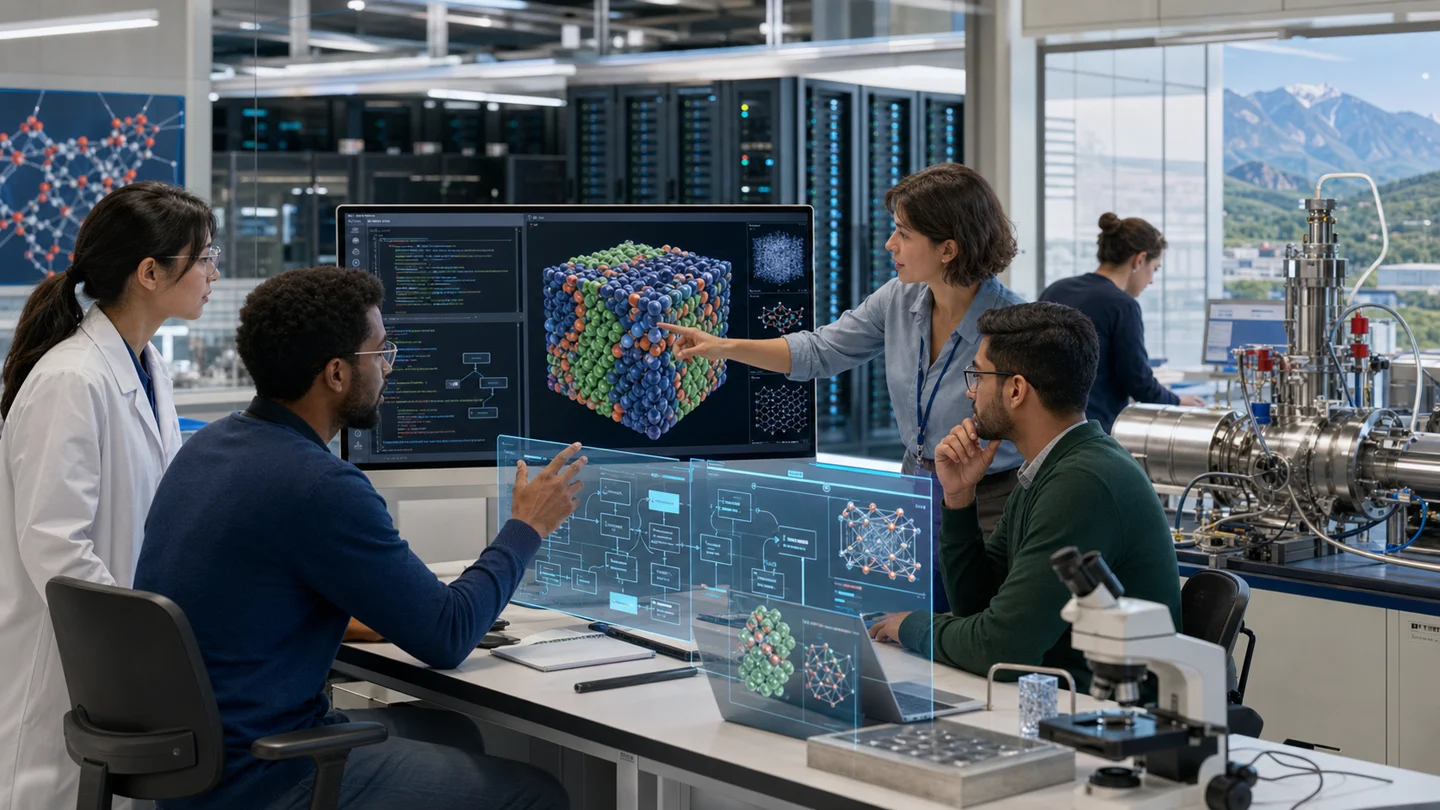
Coding agents are becoming research infrastructure
OpenAI announced a substantial package for the U.S. Department of Energy's Genesis Mission: $4 million in Codex access for roughly 2,000 participating researchers, $3 million in API support for two large scientific campaigns, and an offer of up to $10 million in API usage for $2.5 million spent. The program connects frontier models with national laboratories, universities, scientific facilities, data, and high-performance computing.
The headline is funding, but the operational story is integration. Modern research depends on large codebases, simulation pipelines, instrument-control software, data cleaning, and reproducible analysis. A coding agent that understands those workflows can help researchers move between an idea and an executable experiment more quickly, provided the surrounding systems preserve scientific traceability.
Where the time can be saved
Scientific teams spend significant effort on work that is essential but not itself the final discovery: adapting old code, connecting datasets, writing analysis scripts, documenting environments, reproducing a collaborator's result, and translating a method between computing systems. Coding assistance can reduce this friction and make specialized infrastructure more accessible to researchers who are experts in their domain rather than in every software layer.
The benefit is strongest when the agent can work with the same tools scientists already use. That means repository context, cluster schedulers, simulation packages, notebooks, data catalogs, and laboratory workflows. A general chat interface may explain an algorithm; an integrated coding system can help turn that explanation into a versioned, testable research artifact.
Ambitious campaigns need disciplined evidence
The initial campaign concepts include higher-temperature superconducting materials and an atlas of scientific problems that may be tractable with existing knowledge, data, and computation. Both are well suited to AI-assisted exploration because the search spaces are large. They are also areas where a fluent answer is not evidence.
Scientific use therefore raises the quality bar for agentic coding. Generated code must record its inputs, versions, assumptions, and outputs. Simulations need sanity checks against known results. Statistical work needs reproducible seeds and transparent methods. Experimental claims still depend on measurement in the physical world. The agent can accelerate the route to a hypothesis, but validation determines whether the result survives.
A human-led model for AI science
OpenAI's announcement explicitly keeps researchers at the center of question selection, methods, challenge, and validation. That is the right design principle. The best near-term role for coding agents is not autonomous scientific authority; it is a force multiplier for teams that already understand the domain and can recognize when a result is implausible.
If the program succeeds, its most reusable output may be a set of working patterns: how to connect agents to secure research environments, how to audit generated changes, how to measure productivity without rewarding shallow volume, and how to preserve reproducibility while moving faster. Those patterns could matter far beyond any single model or scientific campaign.